Sunday, May 9, 2010

Updated Pics of Front Area

Fruits painted in frames.  Nutritional information will soon be added. 

Thanks to Carey and his mother, Alberta, for donating a green couch in perfect condition (on right).  The color of the sofa is ideal for the shop. 


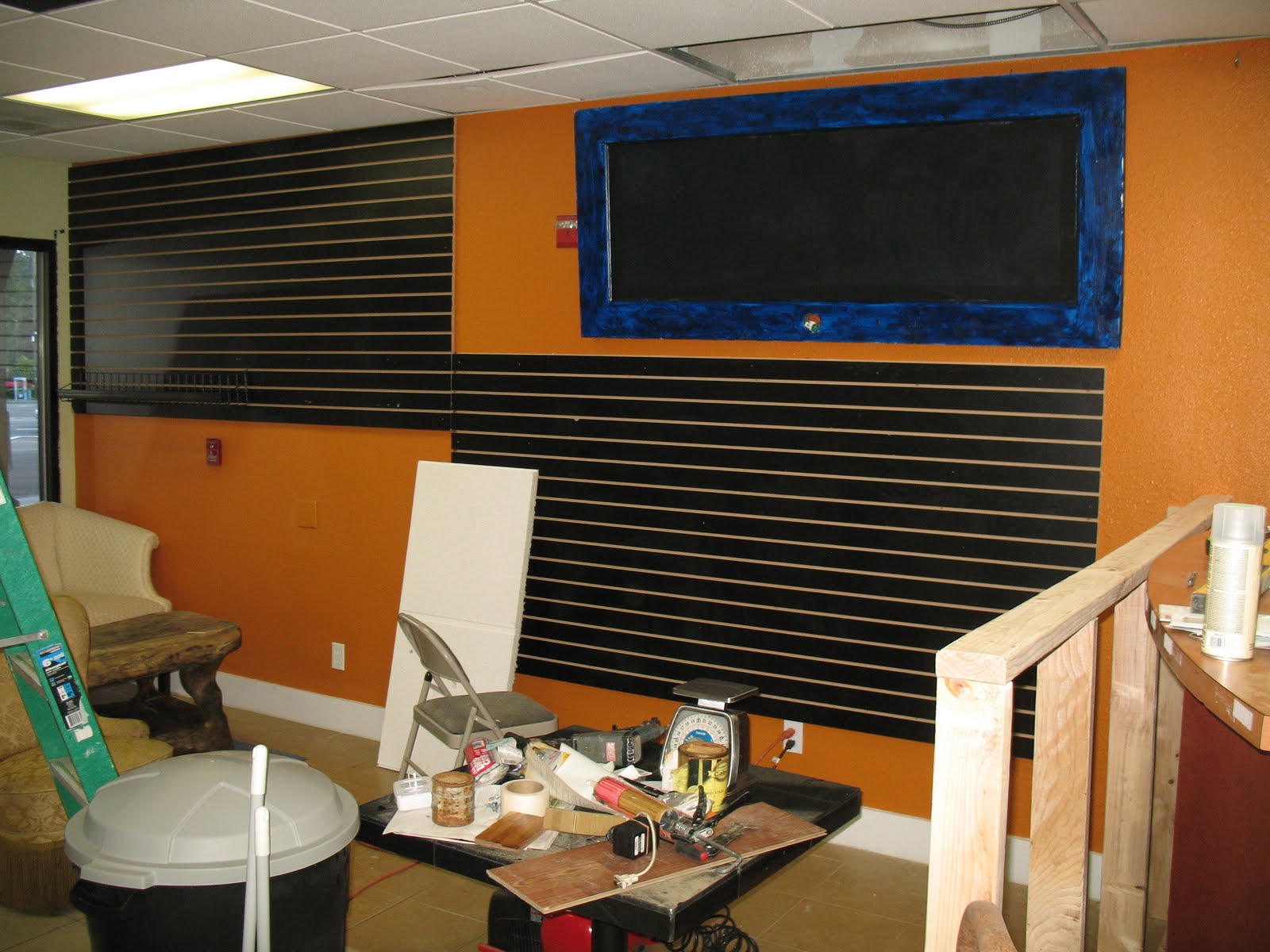
Menu board and wall slats up.  We're leaning toward replacing the orange with a light green. 

Another wall slat (thanks Reuben!) and a church pew we purchased from now defunct Chez Gaudy.


Beginnings of our bar seating area. 


We're exhausted so not much commentary on any of these pictures.  We'll add more to this employee training manual tomorrow.

Friday, May 7, 2010

The Smoothie Lab

All our smoothies are developed in-house.  Our goal is to pack as much nutrition per dollar into each smoothie.  Each smoothie will target specific needs. There'll be smoothies made for those who want a lot of protein and few calories.  Other smoothies will be heavy on complex carbs.  There'll be smoothies made for those who want to lose weight, and for those who want to gain weight. 

Since we're neither chemists nor physiologists, we don't have a high-level understanding of how to develop a smoothie that meets the taste requirements of our customers.  But we have a basic understanding of the scientific method.  We research and use trial-and-error to figure out how to build the nutritious smoothies that meet customer taste expectations. 

Today, we learned that mango kept in cool (40-55 degree) temperatures take a long time (more than 2 weeks) to ripen.  Mangos that aren't ripe are tart.  Since most customers want smoothies that taste sweet, we have to figure out a way to ripen our produce so that we can predict when they're ready to be prepared.  Customers will expect consistency in the taste of our products so we can't just use any fruit when making a smoothie.  We have to know when a fruit is ready to be used.  Our employees are expected to have an eye and nose for the ideal fruit.  They need to develop a *discriminating* palate. 

It's risky to use only fresh fruit and high-quality juices to make smoothies.  The only way we can make this work is if we develop an efficient work-flow process that reduces waste and have employees who have discriminating taste when it comes to fruit and vegetables.  Furthermore, we expect customers to purchase our products primarily because of the expertise of our employees.  If we don't understand fruit and vegetables better than the average customer, then they might as well make their own smoothies.  Our expertise is as much as a value add as the convenience we provide to customers. 

(To Alaska Airline employees - we apologize for the tart smoothies.  We'll send over sweet (not sugary) tasting smoothies that'll meet your taste and nutrition expectations. In exchange, you'll have to taste our Jalapeno-Yam smoothie).

The purpose of the smoothie lab isn't to develop the ideal smoothie, just as automobile manufacturers don't try to engineer the perfect car for average customers.  The ideal, the perfect isn't cost-effective.  Our purpose is to create smoothies that add enough value to our customers so that they'll purchase our products.  We try to improve lives, not to make people live the ideal life.  We don't make porn.  We provide practical nutrition. Someone else can make pornographic smoothies.

Thursday, May 6, 2010

Scrap Wood Wall

We've completed the scrap wood wall.  Building a scrap wood wall was a risky decision not so much because it's unusual for our area (more on that in another post), but because it's difficult for amateur interior designers and construction workers like us to make what's typically found in garbage look inviting. 

We based our design on scrap wood walls found in Seattle's Frank's Champagne and Oyster House and some of the ramen and izakaya shops in Vancouver BC.  The ones we've seen look dramatic, sophisticated, cozy, and inviting.  We realize that such a design may not be appropriate for a smoothie shop, as drama and sophistication may turn out ridiculous in a setting that sells smoothies in take-out plastic cups.  But we decided it was worth the risk. We want to redefine the smoothie experience (a blog post on this later) and create a shop that's a public meeting space.  In other words, we're trying to build a design that's a mix of Starbucks and Jamba Juice. 

After consultation with gym members and our architect, we decided it was best to paint over the wood with fruit colors.  Most thought that stained wood doesn't mix well with smoothies.  The bright colors remind people of fruit and smoothies, the wall texture makes for interesting design, and the use of scrap wood fits well with Seattle ethos of "recycle, re-use." 

Andrew nearly tore out the scrap wood wall.  Andrew built the wall, so it became a reflection of himself.  For him, looking at the wall was like looking at himself, and he soon only saw zits and other imperfects.  He saw ugly and insecurity.  He hated it and had a breakdown. 

Wan reassured him that the wall wasn't as bad as he thought.  She dragged gym users into the shop and asked them to share their opinion about the wall.  Andrew pestered his architects for their opinion.  Not everyone liked the wall, but all thought that it could work.  All it needed was some make-up to hide the imperfections and to properly express our ideas. 

Now that the wall is painted, Andrew is much happier with it.  Wan, not as much.  She did much of the painting so at one point, she felt that the wall was a reflection of herself and all she saw was ugliness and insecurity.  But that's another story. 

Anyway, some pics. 


We'll paint pictures of fruits and vegetables and their nutrition information about their content within the frames.  Updated pics this weekend. 

We probably should've been more deliberate in how we set the wood scrap pieces.  The good news is that it's very easy to change the texture of the wall.  We may do so in the future.  For now, we're happy with it. 


On the left is a more traditional scrap wood wall that we've seen in some Japanese restaurants (without the paint).  Simple and clean yet distinctive and textured. 


Here we built faces.  The mouth will be used as bookshelves.  We'll also put something in the noses.  It's hard to make out the faces from the photos.  The facial contours are clearer when you see this wall in person.  
Andrew was against using a shade of green that he hasn't seen in nature.  He didn't want colors that seem artificial because we're avoiding use of artificial ingredients.  In the end, we decided it was okay to add some artificiality to our color scheme, especially since this color feels so refreshing. 

Despite its imperfections, we're happy with this wall.  It's generated much more talk than we expected and most people find it interesting but not offensive, and some love it, even if it doesn't look refined.  We think it'll become an effective marketing piece.

Update: fruits are in the frames.  We just need to add information about them.  Pics coming soon.

Wednesday, May 5, 2010

To Prospective Employees

Those interested in a position with Fresh Fruit Smoothies need to send their contact information to us by Saturday noon, which is when we'll stop advertising for employees.   

If you don't have our e-mail, send your contact information over the blog by including your e-mail on a comment.  Since comments on this blog are moderated, we'll write down your contact info and delete your comment. 

Customer Loyalty Programs

Worth it or not? 

Some considerations:
* We're located next to a gym. 
* Next nearest smoothie shop is 2 miles away. 
* Our products cost 10 percent less than those at Emerald City Smoothie; our margins are probably smaller.  Our products are also unique for the area. 
*  Loyalty program costs

Insights and advice appreciated. 

Tuesday, May 4, 2010

Our Preparation Tactics

We've been preparing to open a food service business for nearly 5 years.  During that time, we learned as much as we could about restaurant operations and we used our home kitchen as a practice space for running a restaurant business.  We invested in a restaurant to gain deeper insight into restaurant operations and budget systems.  We discussed how the lessons learned from our professional work lives could be helpful in operating a restaurant.  (These discussions made our dining experiences much more pleasurable). 

We were always trying to learn about and emulate our favorite restaurants (though not all restaurants we like have been successful).  When we dined at restaurants, we would ask each other about what we thought made the restaurant work, or not work.  We discussed and analyzed the decor, service, food, work-flow processes, leadership, marketing, and overall ambiance of the restaurants we visited.

At home, the first issue we dealt with was wastage.  About 20 percent of what we purchased would end up unused and discarded.  Most restaurants that waste that much don't survive.  We determined the wastage was due to our lack of discipline and poor planning when grocery shopping.  That is, we would purchase what we wanted to eat at the time we were shopping instead of what we needed and could reasonably manage for the week.  For instance, we'd purchase oxtails because we thought we wanted oxtail consomme sometime during the week, but we never considered if we would ever have the time or the motivation to make oxtail consomme.  We didn't consider whether a meal we wanted was possible.  We just wanted it, so we bought the *idea* of it.  We felt entitled to what we wanted.  We thought we deserved it, even though we couldn't make it. 

Our concern with wastage also brought attention to our (lack of) food preparation work-flow process.  We had to figure out a system that would make cooking our ideal meal more efficient and thus, more feasible.  We realized that we could reduce waste by preparing, in one sitting, all the food we purchased.  So we'd set aside a time to prepare food -- chop the garnishes, slice the fruits and vegetables, prepare the marinades and dressing, etc. -- and put them in containers, just as done in restaurants.  We discovered that we could save time and increase motivation to cook-in by doing all our prep work once a week instead of spreading the work over the week.  This made cooking much less daunting after a difficult day at work.  We became more motivated to cook-in instead of eating-out when we didn't have to worry about having to prepare this or that.  Cooking on a daily basis became a simple activity instead of a hassle. Not having to worry about the hassle of cooking reduced our wastage down to 5 percent, still too much for most restaurants to be successful.

So we redefined our ideal home-cooked meals.  We began to read food magazines as pornography, offering perfect meals in perfect settings, prepared by perfect chefs.  We decided that while pornography may offer a model of life, we can only use it as inspiration or fantasy and not as a practical way to meet our nutritional needs.  And if we want to experience food pornography, we'll just go to a fancy restaurant that offers food that we, the flawed, can never emulate. At home, we'd make do with our imperfections.  Our goal became to make meals that fulfill our dietary requirements instead of satisfying our desire for the impossible.  We were surprised to find that this approach made our meals more diverse and better tasting.  Thinking of food magazines as pornography helped reduce our wastage down to 2 percent because we stopped trying to be perfect and started to have fun with cooking. 

We also budgeted as restaurants with seasonal menus would.  Instead of purchasing groceries off a list, we would set an absolute amount of what we could spend on food.  This approach forced us to consider ingredients unfamiliar to us when planning and preparing our meals.  We began think in terms of maximizing nutrition per dollar. 

And we continue to work-out.  Now that we have a health centered smoothie shop, we don't just work-out to look good and to increase our productivity, but also to advertise to customers that what we sell -- not just our smoothies but also our approach to healthy living -- works.

Monday, May 3, 2010

Advice Needed - Using Barcodes

Someone recently mentioned that many gym users don't carry cash or credit card with them when they use the gym.  He's probably right and we're concerned about this issue.  We want to make our products as convenient as possible for our customers. 

He suggested we add barcodes to the gym cards.  That's the most convenient way for gym users who don't carry cash or credit card to purchase our products.  Customers don't have to deal with the hassle of carrying an extra card and risk losing it at the gym.  They can purchase say, 10 smoothies, and each scan of the barcode will ring up a purchase. 

Does anyone know how we can best make this work? 

We won't have a Point of Sales system for a few months.  Our cash register, however, does have a built-in scanner.  We think that an effective barcode system will significantly impact our profitability.